

The average American has about 60 “bad days” per year, or roughly one-sixth of your entire year – which equates to 4,800 days throughout your lifetime.
But what happens when you have even more bad days than that?…
Let’s say 100 or more in a year – or what if your entire year feels like you could just toss it in the bin (it happens).
A bad ‘season’ can cause you to disconnect and become distant from the people who care about you. I know this because I’ve been there. 2022 for me was a year I wanted to forget, and I just wanted to disappear.
After a 9 year relationship came to an end, I was struggling with loneliness, grief, and for the first time in my life, depression. Sometimes seasons arrive in your life that you never thought you were susceptible to. Things you thought would never affect you can blindside you out of nowhere.
Never in my entire life had I experienced depression until I was 32 years old. I genuinely didn’t ‘believe’ in depression.
I know it sounds silly, but I didn’t understand why people couldn’t just snap out of it. You would think throughout my challenging childhood, and my journey to becoming a millionaire by the age of 30, that I would have stumbled across depression and severely difficult mental hurdles already, but I genuinely hadn’t. I’m blessed with the curse of being over-confident. So when something shatters my world, things are really upside down.
Moving forward I know how to handle these situations and I have a better understanding of what causes anger, depression, sadness, and grief (If you can acknowledge the growth on the other side of these struggles, that is where personal progress is discovered).
See, when you’re suffering, your attention shrinks and becomes very self-centered. As a person who already struggled to connect deeply with others, losing the person I was closest to was essentially a death sentence for me.
I had to find a way to crawl myself back out of this hole that opened right in the center of my life. Although it has been my most challenging battle, it’s also now one of my greatest experiences and triumphs. I’ve come to accept that struggling with loneliness, grief, depression, or trauma is simply part of life.
They say that life’s best teachers are heartbreaks, empty pockets, and failure, but when you’re in the middle of them, cute sayings don’t matter much, do they?
Well, how about this one then:
“Dead men are heavier than broken hearts.”
– Raymond Chandler in The Big Sleep
What I’ve come to learn is that massive loss is one of the greatest things that can happen to you. I know you might think “people just wouldn’t understand”. I’m guilty of this too – but people do understand and have been through very difficult times themselves as well.
Sometimes, life is just hard. Sometimes, life just hurts and as with challenging emotions, we need to make the space to recognize and allow these seasons to happen. We often feel stuck in the “low tide” of life.
However, like the tide; we open, expand, shrink, and contract. Fear and grief can keep us stuck in a disconnected state.
What if we learned to ride life’s seasons like a surfer on the waves? Welcome the highs, and navigate the lows. Your life, your journey, embrace its entirety.
In order to to make that easier to accomplish, let’s start with the big picture.
A lifetime, simplified.
Life… a miracle of the universe that is nearly impossible to grasp or understand. How in the world can we make that simple?
Let’s start with a visual representation of what life can look like – demonstrated by the shape of the letter U.
- starting happy (birth and childhood)
- a slump during the middle (midlife crisis)
- happy again in older years (empty nesters and death).
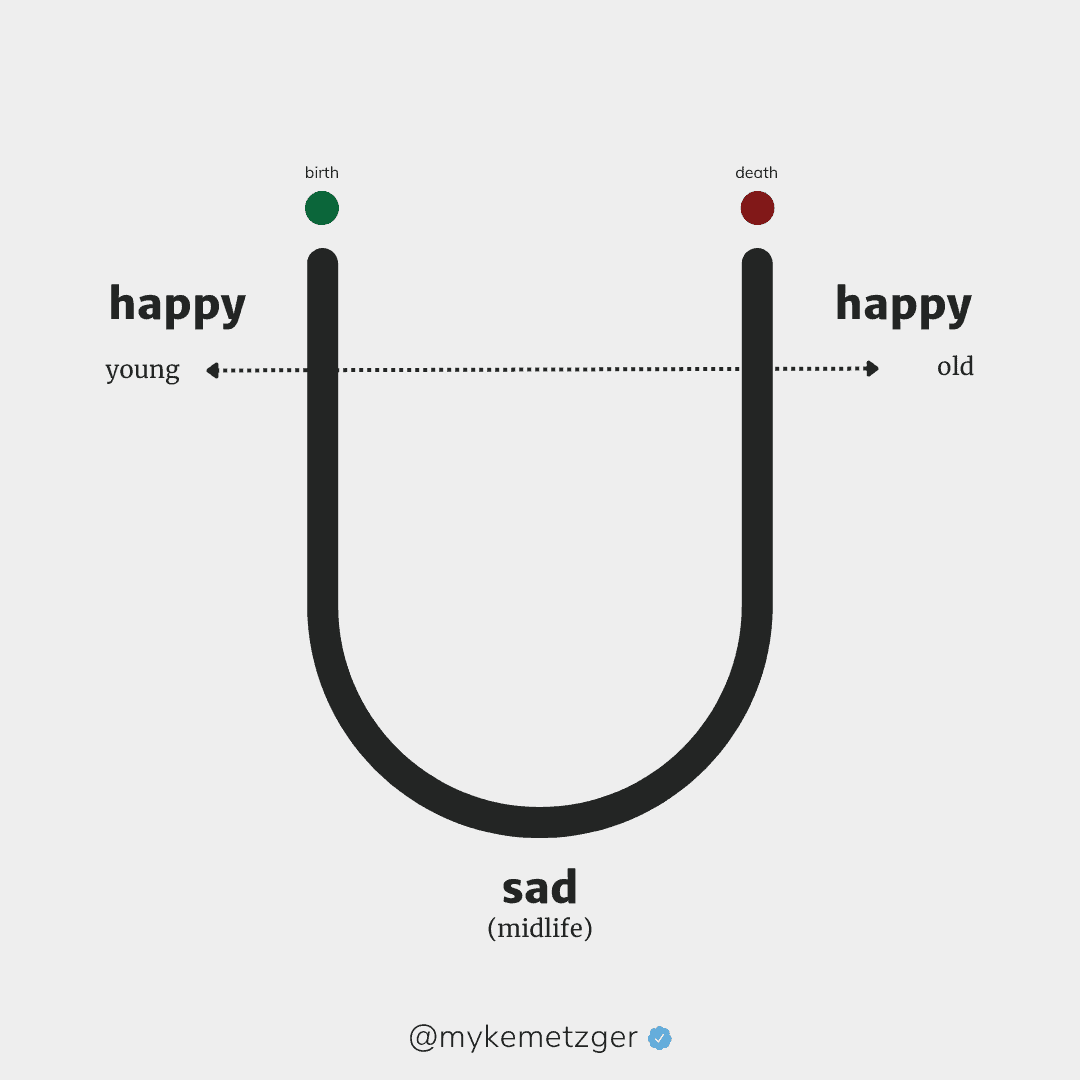
This is a simple outline of how the average lifecycle generally goes.
Now, of course, there is a lot more nuance to life than that – hence the good years and the bad years.
- There will be hard and difficult times as a child and young adult.
- In the same way, there will be amazing times as an adult or during midlife.
There are many rhythms to life, and often they are biological – not just circumstances that happen to you randomly.
Life is not happening ‘to’ you.
You are creating the things that happen within your life, and if you embrace this, your life can improve greatly.
It’s important to avoid “brightsiding” reality with toxic positivity of course. However, we also don’t want to actively seek out unnecessary suffering, hoping to somehow fast-track our way to enlightenment.
In order to understand this better let’s start by identifying our simple biological rhythms:
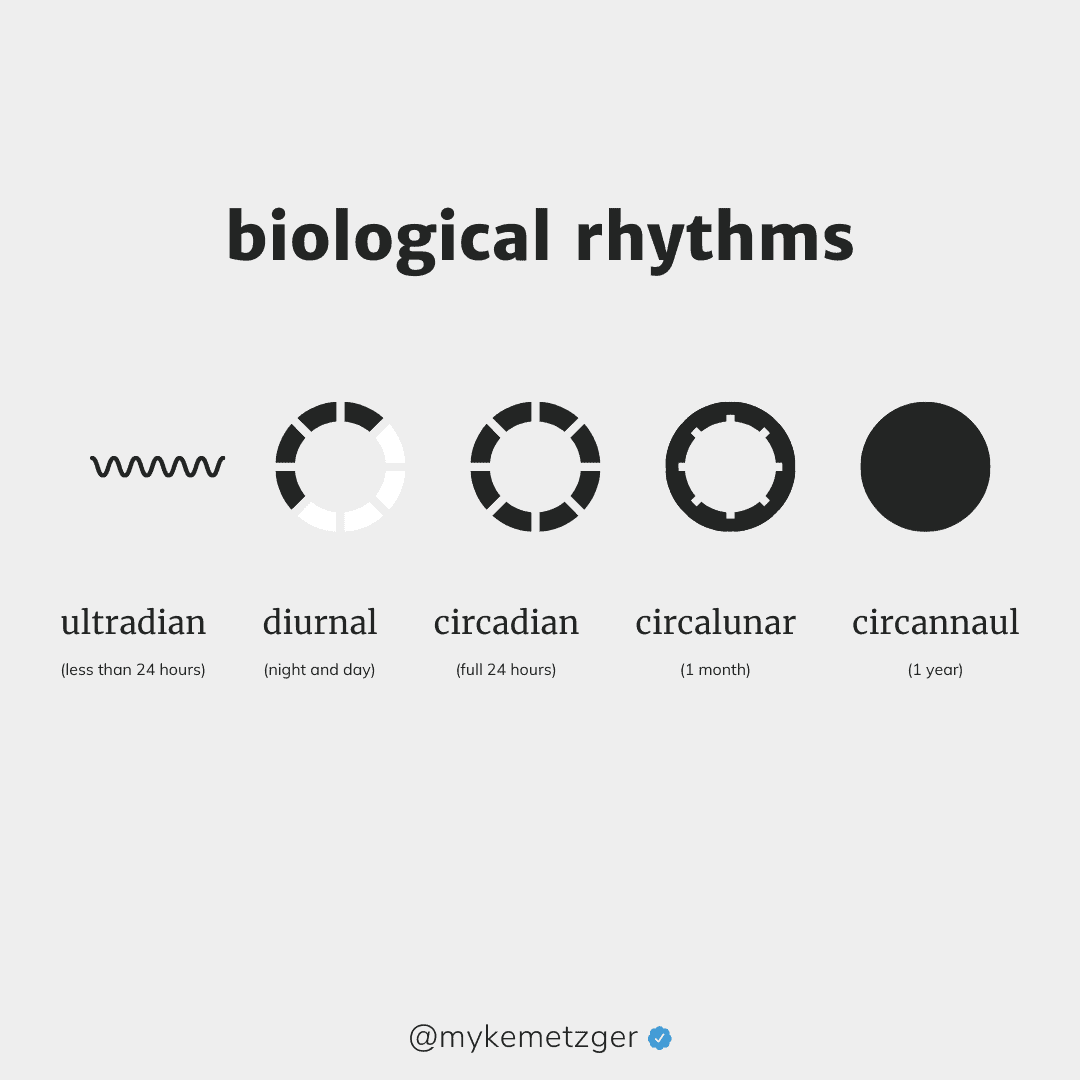
Ultradian (less than 24 hours)
Ultradian rhythms are natural, waving cycles of energy — swaying patterns of energy production and recovery — that occur in people (as well as in other living things) many times throughout the day.
The basics: After 90-120 minutes of sustained energy output and mental focus, the body and brain need a 15-20 minute break. Your systems use that downtime for recovery, repair, replenishment, and rebalancing. After which time, they return to a high level of productivity and efficiency for another 90 to 120 minutes. Rinse and repeat.
Diurnal (night and day)
Diurnal rhythms occur within a 24-hour period, primarily influenced by the alternation of day and night.
The basics: You can align your daily activities and sleep-wake patterns with the diurnal rhythm by following a regular schedule that ensures adequate rest at night and productivity during the day, optimizing energy levels and cognitive performance.
Circadian (24 hours)
Circadian rhythm represents the innate 24-hour cycle that regulates various physiological and behavioral processes in living organisms. Like ultradian rhythms, but bigger.
The basics: By understanding the influence of these rhythms, you can optimize your sleep patterns, meal times, and activity levels to align with your body’s natural cycles, promoting better sleep quality, alertness, and overall health.
Infradian/Circalunar (1 month)
Infradian/Circalunar are biological rhythms with a cycle length of approximately one month, synchronized with the phases of the moon.
The basics: You can notice changes in your sleep patterns, mood, or energy levels in synchronization with the phases of the moon. By paying attention to these patterns, you can adjust your self-care practices, meditation, or creative activities to align with the moon’s cycles – enhancing your emotional well-being and personal growth.
For women specifically, this is believed to affect menstrual and fertility cycles as well.
Circannual (1 year)
Circannual rhythm relates to biological patterns that follow a yearly cycle, often influenced by seasonal changes and environmental cues.
The basics: You can harness the circannual rhythm by recognizing the effects of seasonal changes on mood, energy levels, and physical health. Adjusting daily routines, exercise regimens, and exposure to natural light can help optimize well-being and adapt to different seasons.
All of these rhythms of life can be simply displayed by looking at things linearly:
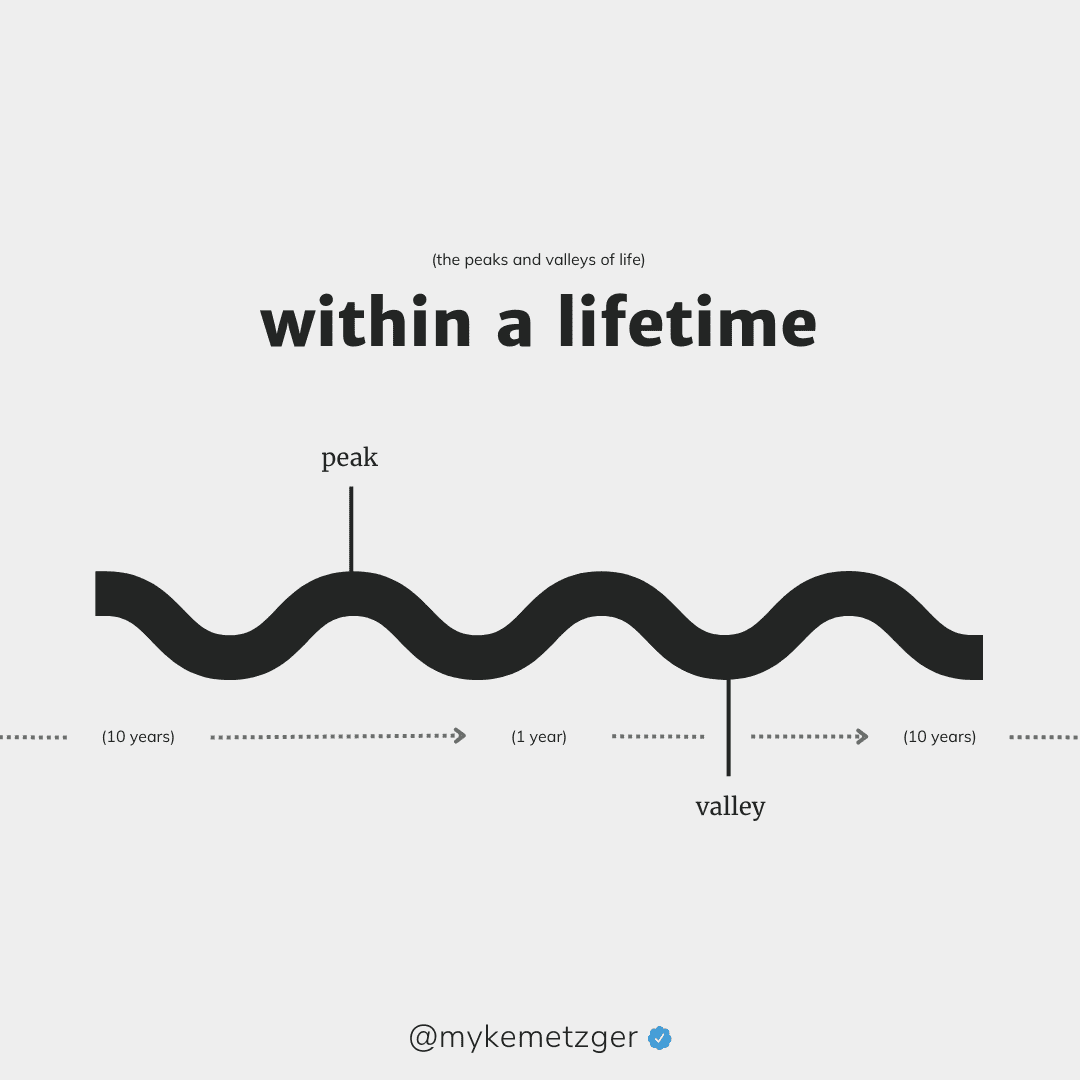
Life is like a roller coaster with its ups and downs.
Sometimes, we experience moments of joy, success, and happiness — the peaks of life.
(These are the times when everything seems to go well, and we feel content and fulfilled. We celebrate achievements, build relationships, and cherish precious memories.)
However, there are also challenging periods — the valleys.
(These are the times when we face difficulties, setbacks, or disappointments. It can feel like everything is falling apart, and we may feel sad, frustrated, or overwhelmed.)
But it’s important to remember that both peaks and valleys are an inevitable part of life. They provide us with valuable lessons, opportunities for growth, and the chance to appreciate the highs even more. The key is to embrace both the good and the bad, to stay resilient during tough times, and to cherish and celebrate the moments of joy when they come.
Even the Chinese symbol of yin and yang reflects this – it is a helpful touchstone when we’re weathering a formidable storm. The concepts of yin and yang have been around since at least the 1300s BCE, over 3,000 years ago. The light is implicit in the darkness; the darkness is implicit in the light.
Living a fully engaged life means recognizing and holding both.
Pursuing either extreme is what keeps us small and disconnected.
If we zoom in even further, you’ll see these same exact patterns in your day (remember, ultradian rhythm).
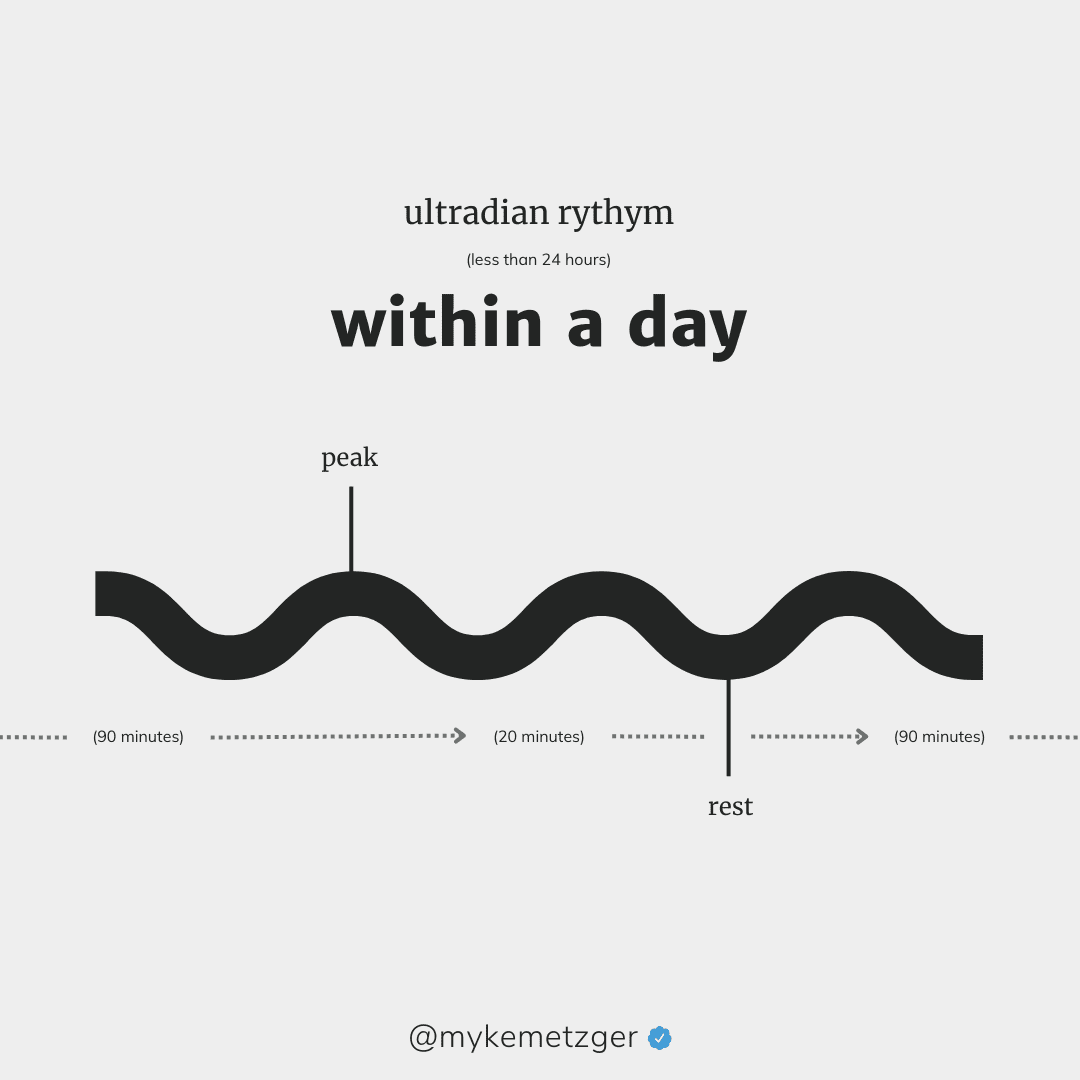
Are you utilizing the ‘ultradian rhythm’? If not, it’s time to start.
It’s your brain’s natural ebb and flow.
Swap your ineffective work routine for 90min blocks instead, then take a 20min breather.
You’ll be amazed. Focus stays sharp, mind stays fresh, and burnout becomes a thing of the past.
“Managing your ultradian rhythms ranks in the top five most important things you can do for your wellbeing.”
– Pilar Gerasimo, author of The Healthy Deviant
Understanding life seasons
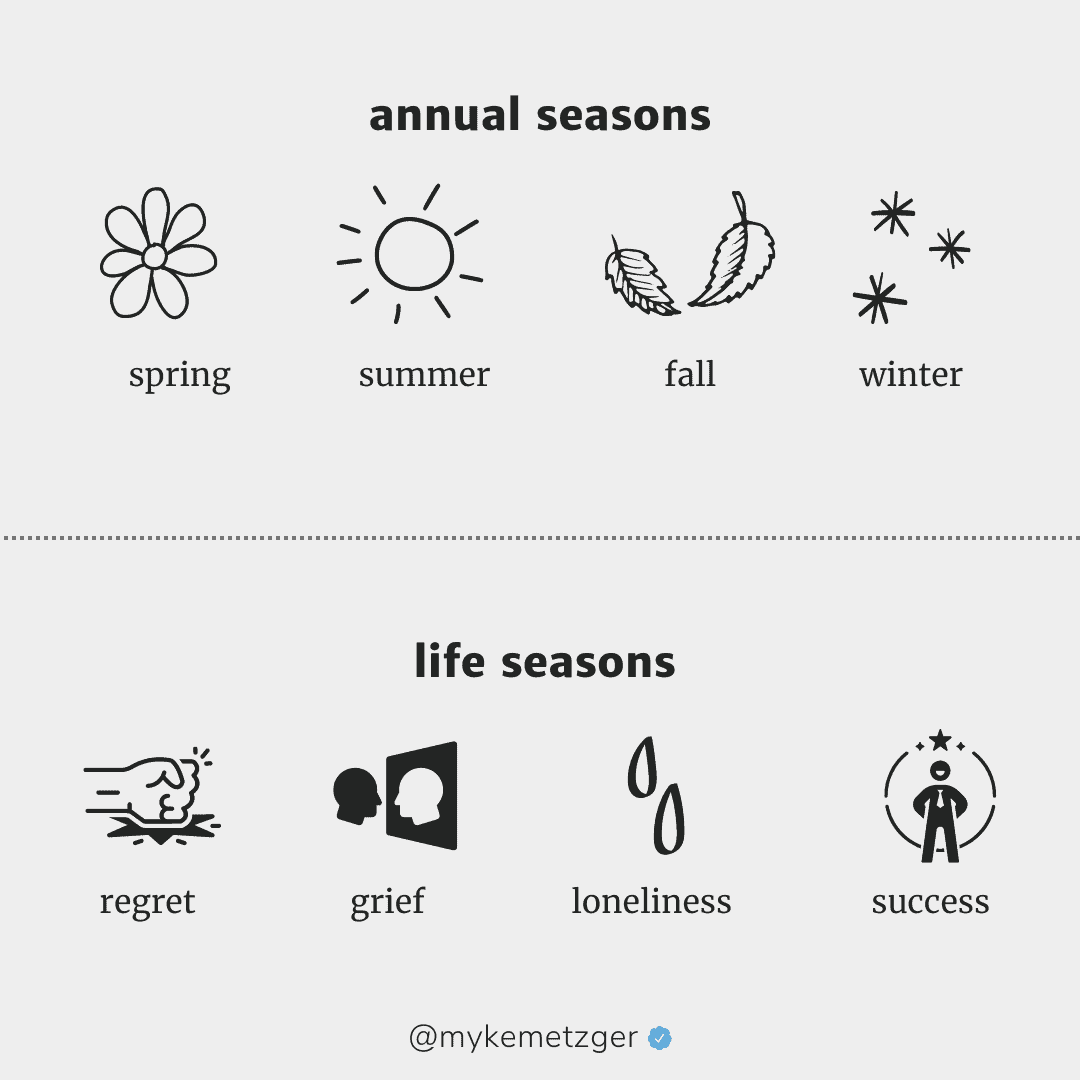
Annual Seasons:
- Spring offers new growth, and time to enjoy beauty and reap rewards. If we’ve done our hard yards throughout Winter and Autumn we will see beautiful growth start to bloom.
- Summer is a time to drink in the sun’s long-awaited warmth, but also ensure we self-care and don’t burn ourselves in the warm fires of life. So many pleasure junkies who refuse to endure the harder seasons spend their lives chasing the sun, only interested in the good times. This season is a time to relax and play, so we recharge and prepare for the harsher seasons that will cycle again next year.
- Autumn requires we prune back, turn over the soil and prepare to plant needed seeds of growth.
- Winter requires us to acquire wisdom on how to conserve fuel (physical, emotional, financial, intellectual, and sexual).
Life Seasons:
- Regret is dwelling on past decisions and mistakes that can foster anger and loss of focus, ultimately fueling the same cycle to continue.
- Grief is often invoked through devastating news and painful loss. This loss almost certainly involves drastic changes in your life, whether it’s due to heartbreak, losing someone you love, or missing a life-changing opportunity.
- Loneliness is part of life, but it comes and goes. Loneliness helps us discover, sculpt, and love ourselves in order to create a higher awareness of self.
- Success is what we all strive for. In simple terms, happiness. Success is different for everyone – but one thing that will always be constant for everyone is that happiness is found within the journey and the process, not at the destination or finish line.
In the same ways our activities change from season to season in our real world, we need to change our activities in our physical and mental seasons as well.
Examples:
- Every winter you might bring certain plants inside, prepare your lawn, maintenance your HVAC system, or prepare your doors and windows for drafts.
- Every spring you put your plants back out, water your grass, work on outdoor projects or pressure wash your home.
In this same fashion, you should be prepared to ‘maintain’ your life throughout its different seasons.
Examples:
- Feeling depressed? Get prepared to put in some exercise (it can be light), quit drinking/drugs for a bit, and set boundaries with your digital devices.
- Feeling lonely? Go on walks and find opportunities to simply say good morning every day while passing a stranger. Take yourself on dates such as to the movie theater or the go-kart track.
Life has a habit of throwing curveballs
Sometimes, they hit us in the form of health problems that limit our physical capabilities.
But remember, being physically impaired isn’t the end-all. There’s a world of experiences waiting which aren’t defined by physical prowess.
Ever felt lonely as if there’s a void in your soul? It can be excruciating, but it also holds the potential for transformation.
You can turn loneliness on its head by channeling it into acts of compassion. Caring for others fills that void and adds meaning to life. You are never alone when you’re making a difference.
Isn’t it true that the sting of grief is a reminder of having experienced pure love?
Take comfort in that fact. The pain of loss is a testament to the beautiful connection that once was.
“It’s better to have loved and lost, than never to have loved at all.”
– Alfred Lord Tennyson
We stumble, we fall – every day.
But don’t forget that for every fall, there’s a moment of triumph that follows. Failure and success are two sides of the same coin. It’s all about where you allow your focus to be.
Don’t let life’s curveballs define your journey.
Acknowledging your life seasons
We’ve all avoided feeling certain emotions at some point – but when this becomes a habit, we sacrifice living a fully engaged and abundant life. When disengaged living becomes habitual, intentional practice is needed to return to clarity and connection.
So how do we re-engage when we don’t feel like it?
“I’ll do it tomorrow” is an easy excuse. It’s easier to stay on the couch and watch Netflix and distract yourself from the problem than to take action. Cheap dopamine such as social media apps, porn, easy hookups, etc. is generally free and easy to find.
But the reality is: The best solution to inaction is massive action.
For me, I did just that and took all-out massive action. To snap myself out of a funk I committed to a 60-day personal challenge, where I forced myself to complete a daily checklist. My life completely changed in just 2 months.
I researched different challenges such as 75 Hard and Project 50, but I ultimately decided to create my own similar challenge that fit my goals. For now, I’m calling it Commit 60 and you can learn more about that experience in detail here.
I created a list of what I called ‘Daily Targets’ which consisted of the following:
- Wake Up At or Before 8 am (M-St)
- Outdoor Exposure
- Workout / Exercise (M-St)
- Reading / Audiobook
- Focused Work (2hrs M-F)
- 18 Minutes of Hobbies
- Social Interaction (M-St)
- No Alcohol
- 1 Coffee or Less
- No Porn
- 20 Push Ups / 20 Sit Ups
- Write Short Form Tweet
Now at first glance, this might seem like a simple list – but that’s also the point. You need to be realistic about what life season you are in, and set challenging but reachable goals in order to move yourself forward rather than backward.
Passion sees you over the line when the going gets tough
Knowing in the back of your mind that you’re making progress because of adversity is a reason to celebrate in itself and lighten your mood.
I included hobbies because nothing will provide more enduring – and more sustaining – clarity and connection than your aspiration, so keep it close, engage, and share it wholeheartedly with the world.
Exercise is non-negotiable and must be on your list. Find your own small and unique passion for a simple type of exercise, whether it be walking, riding a bike, or doing pull-ups daily – find something that makes your heart truly beat.
Even though suffering is inevitable, it doesn’t have to keep you from living well.
Changing your physical and mental environment
Changing our external landscape – whether to greenery, endless ocean, or the night sky – can be a profoundly efficient way of changing our internal landscape. Not only does doing so shift our perspective; but it can also give rise to awe.
Awe is a precious emotion that’s summoned in response to the sacred or sublime. We typically associate awe with breathtaking natural vistas. But, as Salzberg experienced, it can equally be found in music and art. If there’s any emotion capable of instantly teleporting us to a fully engaged life, it’s awe. Admittedly, though, it’s also hard to engineer. Fortunately, its close relations – curiosity and gratitude – can easily be inserted into your day.
Curiosity can work wonders.
Take a second to sincerely examine your breath, the sun, or whatever engages you at that moment. You’ll find that your stresses quickly fall away.
Expressing gratitude is effective at focusing you even if it isn’t for anything, particularly “special.”
Can you appreciate your morning tea, a child’s laugh, or the beautiful sunset?
By all means, whisk yourself off to the theater or mountains if you’re able, but don’t forget that curiosity and gratitude are potent – and readily available – remedies for life’s harder seasons.
If you aim directly at happiness, you’ll always miss it. Happiness is elusive if you’re constantly chasing it. Obsession with personal joy can easily lead to your own misery.
Irony? Perhaps.
Realize this – truly happy people focus elsewhere, not on their happiness. “I’ve reached the end of my life and I realize I’ve only skimmed the surface.”
– it’s a frightening thought. None of us want to be in the position of feeling like we’ve never fully embraced life’s joys or metabolized its sorrows. And yet, for many of us, this is our day-to-day experience.
Giving yourself the gift of being able to say “that was a life well lived”. Embracing greater personal freedom, happiness, abundance, and joy.