

(Listen to the audio version of this article here.)
We all have our favorites.
Pro athletes, rockstar musicians, our favorite singers and artists, world class performers, Hollywood actors, and more.
When someone mentions your doppelgänger as Ryan Gosling, Jennifer Aniston, or whoever you look up to – there’s a reason you blush.
I’m not a fan of celebrity worship and I’m sure you aren’t either, but consider that the people we like and look up to the most are the ones that we feel in some way resemble ourselves?
We do this at an unconscious level.
This is the ego within us that feels that we are like the idols and heroes we look up to, and we see the smallest pieces of ourselves in them.
In an even weirder way, sometimes the real people within our own lives seem to have characteristics that almost categorize them.
Have you ever thought to yourself:
‘Wow, this person looks like, talks like, and almost has the same mannerisms as [insert person you know].‘
What if there was an explanation for this?
These connections and fascinations can be seen as clues to our inner world.
The more we explore and integrate these “hidden” aspects, the more balanced, authentic, and self-aware we become.
Essentially, what we’re drawn to is often a mirror — showing us not only who we are but also who we’re capable of becoming.
It’s why we absolutely love an underdog story.
It’s the reason we love people like Michael Jordan, Jim Carrey, J.K. Rowling, Lewis Hamilton, and Mike Tyson.
They give us hope that we can achieve something great. They show us it’s possible. So our ego wants nothing more than to have something in common with these people, and it just so happens – all of these individuals of course have their own ‘brand’ they are associated with.
As an underdog myself with over a decade of marketing experience and whose clients have a combined 30+ million followers (I myself have over 200K), I know a little bit about branding, storytelling, and building an audience.
Fun Fact: One of my personal favorite underdog stories is Rulon Gardner, a 29-year-old Wyoming farm boy who defeated Alexander Karelin in the 2000 Summer Olympics in the sport of Greco-Roman wrestling. It was Karelin’s only loss. I started wrestling at the age of about 6 and continued all throughout young adulthood. My father is even in the National Hall of Fame for his Lifetime Service to the sport of Wrestling.
Alexander Karelin is considered one of the greatest Greco-Roman wrestlers of all time, and went undefeated for 13 years before losing to the underdog Rulon Gardner.
Why We’re Drawn to Things that Mirror Us
We all are drawn to things unconsciously based on aspects of our identity that we value most.
This is based on our own ego, and we all do it.
If you are someone wanting to build a successful brand around yourself, attract millions of followers, and build a cult-like fan base; you need an ego (and a big one), but this does not mean thinking you are better than everyone.
That’s simply just arrogance.
Instead, ego is the level of confidence you have in yourself and your abilities.
It’s the silent promise you make to yourself that you can handle your shit without having to tell everyone about it.
Ego isn’t about showing off or trying to impress others. It’s about having a strong belief in what you’re capable of.
It’s when you know you have the skills and strength to face challenges, and that belief helps you stay focused and determined.
This creates an insanely fine line between what is seen by others as either vanity or authenticity.
Vanity is an excessive pride in or admiration of one’s own appearance or achievements.
Authenticity means you’re true to your own personality, values, and spirit, regardless of the pressure that you’re under to act otherwise.
It means you’re honest with yourself and with others, and you take responsibility for your mistakes. Your values, ideals, and actions align.
The ego is neutral, until it is assigned a state of being.
The ego is simply a sense of self-esteem or self-importance. That sense can be good or bad.
This is why the word ego itself needs a describing word when being used, such as ‘big’ or ‘small’ or ‘damaged’ ego.
What does it mean to “have an ego”?
Before we move on, we need to agree on what the ego actually is.
The ego itself is a simple collection of the parts of the personality which are regularly expressed consciously, which cluster together to form a kind of unity.
Let’s go over some simple definitions of each of these “parts” of our personality:
- Shadow: The part of you that feels weak, nervous, or scared. It might show up as feeling anxious, sad, or overwhelmed.
- Ego: The core part of you that feels sure, strong, and brave. When your ego is in charge, you feel calm, confident, and safe.
- Self: The version of you that feels the most like “you.” It’s the part of you that you listen to and trust the most.
- Persona: The often unintentional “mask” that you show to the outside world, often used to hide the Self, Ego, and Shadow.
- Brand: The image or identity you create intentionally, to show specific qualities, values, or ideas to others. It’s how you want others to understand and remember you or your work.
In Mid 18th century Latin the definition of persona is literally ‘mask, character played by an actor’.
Brand (unlike the persona, which can be an unconscious mask) is more of a public reputation that you shape intentionally.
More on personal branding later.
Psychologist Carl Jung described the persona as the face you show others to hide your deeper feelings or true self (what he called the anima).
So, your persona might look one way to others, but there’s much more to you within different parts like your shadow, ego, and true self.
The shadow holds the characteristics which have been sidelined, ignored or rejected for one reason or another.
These can be ‘positive’ and ‘negative’ characteristics, often all mixed in together.
The Shadow, Persona, Ego, and Self are most often unconscious.
Whereas your Brand is conscious.
If you’re reading this, it likely means you have a healthy ego, or are well on your way to one.
Those with unhealthy egos would likely never be self-reflective enough to learn about the topic of ego.
Why You Are Your Own Favorite Brand (And Why You’re Other’s Favorite As Well)
Welcome center stage: Implicit Egotism Effect – which simply means we are generally drawn to the things and people that most resemble us, and it is a philosophical concept that I find very interesting.
It is the tendency to unconsciously favor things that are similar to oneself. It’s based on the idea that people’s positive self-associations influence how they feel about things they associate with themselves.
Implicit egotism doesn’t mean you’re vain (remember vanity versus authenticity) — not precisely, anyway. Rather, it means that you just naturally prefer people, places, and things that resemble yourself (e.g, the letters in one’s name). We all do, it’s normal.
We’re naturally drawn to traits in others that reflect parts of ourselves — both the ones we admire and the ones we hope to avoid.
We see parts of ourselves in other people, often without realizing it. These could be qualities we admire or dislike, but either way, they reflect something about us or even balance us. Instead of recognizing those traits as our own, we “project” them onto others, thinking they belong to them instead of us.
From our closest friends to the brands we support, and even the places we live, our choices often reveal the parts of ourselves we unconsciously want to embrace (or reject).
Throughout my life I’ve had some of the most wild and chaotic figures as very close friends.
This expresses my desire to drift towards a bit of chaos. I think it balances my orderliness and OCD tendencies, and I want that adrenaline and craziness because it’s freeing. I am a gemini after all.
The concept of Implicit Egotism Effect was first deeply developed by psychologists Brett W. Pelham, Matthew C. Mirenberg, and John T. Jones.
They introduced this idea to describe how people are unconsciously drawn to things, places, and people that remind them of themselves, such as names, initials, and other personal characteristics.
Their research demonstrated how subtle, self-related cues could influence decisions and behaviors in ways we might not consciously realize.
They conducted 10 studies across 2 major life decisions:
- Where people choose to live
- What people choose to do for a living.
- Studies 1–5 showed that people are disproportionately likely to live in places whose names resemble their own first or last names (e.g., people named Louis are disproportionately likely to live in St. Louis).
- Study 6 extended this finding to birthday number preferences. People were disproportionately likely to live in cities that began with their birthday numbers (e.g., February birthdays in Two Harbors, MN).
- Studies 7–10 suggested that people disproportionately choose careers whose labels resemble their names (e.g., people named Dennis or Denise are overrepresented among dentists).

This clearly suggests that people’s positive automatic associations about themselves influence their feelings about almost anything else that people associate with the self.
The desire to maintain positive feelings about the self influences whether people:
- think lesser of those who criticize the government
- sabotage the performance of others when playing a game or sport
- find rational or humorous in social beliefs and behavior
In short, a great deal of evidence suggests that the motivation to feel good about the self plays a role in a wide variety of important social behaviors.
Building a Brand that Reflects Your Audience’s Identity
Building a brand is not about what other people want to see, it’s about your ability to know who you truly are.
You are the epicenter – the highest point of influence and leverage.
Every piece of your brand’s identity flows directly from you.
You’re not just the face of the brand; you are the brand.
The more aligned and authentic you are with your identity, values, and vision, the more your brand resonates with others. By strengthening your connection to who you truly are, every aspect of your brand grows stronger and more impactful.
There has never been a better time to start building a personal brand than right now.
By now, I’m sure you can see how the inherent implicit egotism in all people can help in branding by intentionally making your brand a clear reflection of your (and therefore your audience’s) values, quirks, and ideals.
This is what makes people click follow after viewing your profile.
They either see themselves in you, or they don’t.
To help increase your chances, simply show how characters, settings, and values in your own life align with your potential audience by creating a world that clearly reflects the most authentic version of yourself.
Just be you. Nothing else matters.
The only people who might have a negative opinion of you, are the ones who don’t align with you, and that’s okay.
The faster we get those people out of the way, the better and closer you will be to discovering your own tribe.
The people who align with you want to get to know you, want you to know them, and want to trust your leadership, guidance, content, and information.
They trust it and enjoy it because they see part of themselves through what you make.
These types of online interactions can feel deeply fulfilling because they reveal, complete, or expand aspects of our audience’s identity — sometimes in ways that go beyond what’s conscious.
This is the implicit egotism effect at play.
So in order to maximize your potential as a personal brand, you simply need to strengthen your worldview.
Your worldview is based on things such as your belief system, methodologies, areas of focus, core values, principles, personal experiences, concepts, stories, and your knowledge.
I help my students accomplish this and build their brand’s worldview in my free series 5 Days to Clarity:
Understanding all of these and “locking them in” is easier said than done.
One of the exercises I like most is creating your Purpose Venn diagram.
The diagram is designed to help find your “Ikigai” – a Japanese concept that translates to “reason for being” or “a reason to wake up in the morning.”
The diagram looks like this:
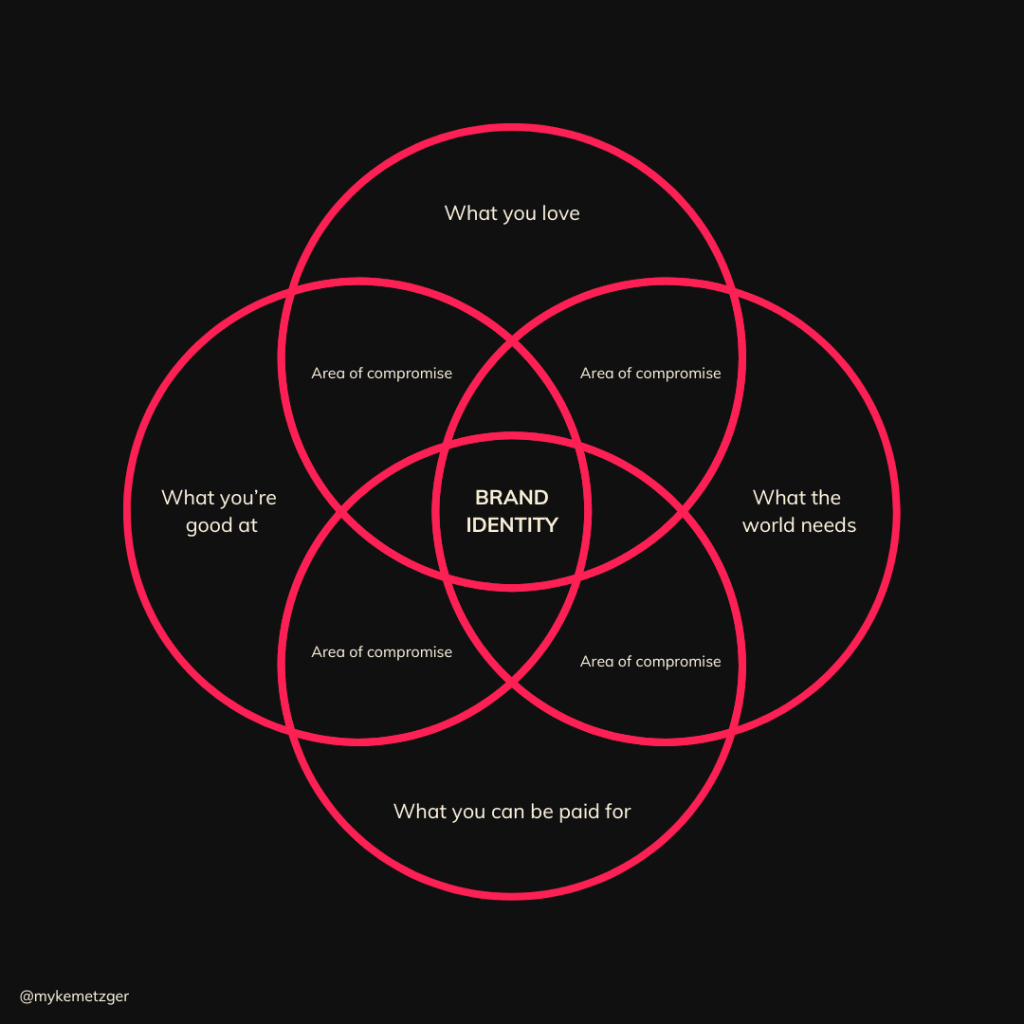
The diagram has four overlapping circles labeled:
- What you love
- What the world needs
- What you’re good at
- What you can be paid for
The center of the diagram represents the “sweet spot” where these four aspects align.
People often mistake the Purpose Venn Diagram for “Ikigai” itself.
But it’s important to clarify that the Purpose Venn diagram is a tool.
Ikigai is the result that the tool is trying to help you accomplish.
Ikigai is deeply personal and rooted in culture, emphasizing well-being, balance, and gratitude rather than external success or achievement. It’s about finding meaning and direction in life, which could come from something as modest as planting a garden or spending time with loved ones.
So what does this have to do with building a personal brand?
The Purpose Venn diagram allows you to balance your “Ikigai” with a way to get paid for what you love, and to build an audience that also loves the same things, which is exactly what you need if you’re building a brand.
It is not “for” anyone. It is for you. It is about becoming the “integrated person,” also known as individuation.
It is about the journey toward self-actualization.
This process involves integrating different parts of the self — both conscious and unconscious — to become a whole, unique individual.
You are the niche.
This is why the people we love are always so unique.
We know their quirks, values, interests, traits, and personalities.
The reason I feel so strongly about this is because the desire to build a brand is what led me to writing and speaking.
It’s what led me to publish my first book, speak on my first stage, and earn my first million dollars.
This is why I say it is a lifelong process. It begins with developing the persona; the social face we show the world, and then gradually integrating deeper parts of the psyche.
I hated reading and writing as a kid.
Somehow, it’s all I do now and I couldn’t imagine my life without it.
Something deep within me that may have never been discovered was finally found all through the act of exploring my own shadow, ego, self, and persona (my brand).
You cannot build a successful personal brand without these aspects of yourself.
This is how you become what is known as “integrated”.
Becoming an integrated person leads to greater self-confidence, wisdom, and the ability to navigate challenges with resilience and authenticity.
This how we create genuine connection with others, as an integrated person no longer hides behind masks or fears judgment for their true self.
This concept of integration ties beautifully with personal branding and finding your authenticity, as it speaks to aligning our outer persona with our inner identity.
Integrating different aspects of ourselves allows us to present a brand message that resonates deeply because it’s rooted in nothing but wholeness and truth – and simultaneously, we achieve true personal growth and fulfillment.
This is why I say there has never been a better time to start building a personal brand, because there’s never been a better time to work on yourself than right now.
Building a personal brand is building “from” yourself, not “about” yourself.
“Self-focused branding can come across as narcissistic.”
Building a personal brand doesn’t mean centering everything on ego or achievements. Instead, it’s about showing the audience a real person behind the brand who embodies certain values and has a clear vision.
When done thoughtfully, this approach actually strengthens empathy and authenticity rather than narcissism.
This allows you to communicate with conviction and clarity, avoiding the slimy, salesy vibe that can come from trying to be all things to all people.
“A brand should focus on the audience, not the creator.”
Of course a brand needs to resonate with its audience. Even though a personal brand is centered around you, it’s not necessarily about you.
Your audience is the hero.
You are their guide.
Any great story isn’t about the guide, it’s about the hero.
You may be the most identifiable and strongest part of your brand, but you simply are what helps the heroes that follow you.
Frodo is the hero. Gandalf is the guide.
Harry Potter is the hero. Dumbledore is the guide.
Luke Skywalker is the hero. Obi-Wan is the guide.
You are not Frodo.
You are not Harry.
You are not Luke.
The heroes are your audience. Becoming Frodo, Harry, or Luke is your audience’s “aspiration”. You are the guide that helps them accomplish their goals and aspirations. Your brand is the tool that assists them in their own journey, and you simply weave your personal experiences, stories, and beliefs into what you share. This is how you become a personal brand that is loved and adored.
When you build a brand focused on you, yourself, your achievements, your ego – nobody can see themselves in that.
The most authentic and lasting connections often come from shared values and genuine alignment. Again, when we understand our own identity, values, and passions, as a creator we can clarify what our tribe stands for and communicate that authentically.
When we have shared ideas, language, and imagery it strengthens the feeling that your brand is “just like them.”
“Too much introspection can lead to overthinking and inaction.”
Looking inward should be balanced with action, but sometimes that is much harder to accomplish than we hope.
When a creator takes the time to look within, they gain clarity on what they truly want to offer and how they want to connect with others.
This clarity reduces second-guessing and overthinking, and instead gathers insights that can inform clear, confident actions to help avoid the “analysis paralysis” that comes from chasing trends and trying to appeal to everyone.
Wanting to create for everyone rather than your tribe is what fuels inaction.
Read: Let Go of the Arrow: How Perfectionism is Destroying Your Life
Benefits and Challenges of Self-Mirroring in Branding
Truly knowing your identity is what creates brand loyalty and a cult-like following.
But it’s quite easy to slip into madness when trying to figure out:
- Who the hell am I?
- What is my brand?
- What are my worldviews?
- What are my core values?
- What are my concepts, theories, and methodologies?
This is because finding the answers to these questions is a deeply personal and philosophical pursuit, and it can often take years.
The reality is that you are not a permanently defined being. You, your brand, persona, self, ego, and shadow will always continue to change, shift, and evolve throughout life.
This is the power of documenting. You want to grow, and you want your audience to grow along with you.
It can be quite difficult to know where to start, so here’s a basic outline:
- Define Your Worldview – Make it fun. Grab a large roll of art paper or canvas and create a mind map of all of the things that are most important to you.
- Establish Conviction – Now that you’ve identified these things, you can feel confident leaning into them knowing that they are a core part of your identity.
- Share Your Journey – This allows you to have clarity around your ideas and being to make content, writing, or art that aligns with your personality and your unique journey.
- Show Results and Proof – If you have a product or service, you can now create tasteful correlations between who you are, the problems you solve, and the solutions you offer.
- Emphasize Your Transformation – Share your journey and document progress and results until you eventually have clients, students, or customers that you can leverage and share their results.
- Create an Aspirational Identity – This is the bridge that you and your audience are traveling together. Starting at point A and always striving towards point Z. Every letter along the way is a different unique perspective aligned with a brand’s identity.
Once you go through this process and mind map it all out, you have to embody it completely.
In order to access the archetype of your desires, when you don’t feel the character, you simply act as if.
In this process, if you cannot “feel” the brand you’re trying to portray, you simply act like the character.
You move and talk as this character would move and talk. You act “as if“.
Pick up your script, read the king’s lines, sit on the kings throne, and act like the king. Pretty soon, believe it or not, you will inevitably become the king.
– Myke Metzger
It’s another way of saying that the way you respect and love yourself, is the leading example that teaches others how to love and respect you as well.
Now there’s of course a difficult side to this.
The more introspective we are, the more it feels like we are living in a small room walled with mirrors pointing back at ourselves.
This can lead you to only stick with what’s familiar, even when it’s not beneficial.
For instance, you might choose a career path that reflects your family background or interests from childhood, rather than exploring a path you’re genuinely passionate about.
This is the “quiet sabotage of creativity,” where you continually seek familiar ideas and avoid experimenting.
Do not fall victim to this.
Keep it weird, keep experimenting, trying new things, and expressing your creativity and authentic self.
Do not be afraid to fail, make mistakes, or screw up.
Although it’s important to spend time building content, products, and services around the what we love and enjoy, it is equally important to deeply consider the specific problem we solve for other people through these products and services.
Here are some questions to consider:
- What do they actually need?
- What is their specific problem?
- What keeps them awake at night?
- What is holding them back from moving forward?
- What is the obstacle to the solution that they need?
- What is their decision process when considering your product or service?
These are all questions that should have an answer to before refining and even launching your product or service.
Being a content creator, personal brand, and artist, or anyone that creates a body of work and shares it with the world is a delicate dance with the devil, and this topic constantly reminds me of Bo Burnham.
Bo is a stand-up comedian, musician, actor, filmmaker, and most iconically, a YouTuber. If you’re currently over the age of 25 you likely remember his meteoric rise on YouTube when we were teens.
His audience is over 10 million people strong, and he’s not a Kardashian or an iconic rockstar. He is an awkward nerdy YouTuber who built a cult-like following by simply being himself and showcasing what he was good at and liked to do.
Burnham’s journey reveals how fame and social media can pull us toward versions of ourselves that might feel true but can also create deep disconnect.
Early on, Burnham’s humor and vulnerability mirrored the awkwardness of his teen audience, drawing people in because he reflected their own experiences and insecurities.
We were all teens growing up together watching Bo’s videos.
But as his career evolved, he began highlighting the darker side of social media:
- the constant pressure to perform
- the emptiness of online validation
- the feeling of being “trapped” by fame
Burnham’s journey can be seen as a struggle to reconcile parts of himself — the performer, the thinker, and the vulnerable human — all while facing the “shadow” of digital culture.
Fame amplifies this disconnect, pushing him to reflect critically on how platforms reward curated personas at the expense of genuine identity.
This is why it’s so important to just be you.
Don’t chase likes, views, and shares.
His decision to step back from the spotlight reflects his need to protect his true self from being fragmented by constant public exposure, illustrating the challenge of being authentic in a world that thrives on endless performance.
So if you’re currently building a personal brand or considering it, be aware of this and account for it within your vision for what the future holds.
- Why do you want to do this?
- What’s in it for you?
- What’s in it for your audience?
- Does it align with your goals and who you want to be?
- Or, is it implicit egotism?
Should I Build a Personal Brand?
There are many content creators that we get to know through our screens.
Feeling like you know them, and resonating with them could make you feel like you also want to be a content creator and build a personal brand – even when that’s not your authentic desire.
If you already know it’s what you want to do, be sure to join the waitlist for the next cohort here.
Remember, we all have a brand regardless of if we want it or not, and now that you’re aware of Implicit Egotism this can benefit you in many ways when considering your future and what lore your brand plays in it.
Here are some steps to help you:
Understand Yourself Better – Realizing you’re unconsciously drawn to what mirrors your identity helps you spot patterns in your choices. Are your relationships, career moves, or lifestyle decisions guided by genuine desire or just a sense of familiarity?
This awareness lets you challenge those patterns and align your actions with what truly serves you and your audience.
Make Smarter, Intentional Decisions – Implicit egotism sneaks into everyday decisions — especially when building a brand and trying to decide what ‘style’ of content to create.
When you’re aware of this, you can stop and ask: “Am I choosing this because it feels like me, or because it’s what I actually want?”.
Master Relationships – People are naturally drawn to reflections of themselves because it’s human nature. Use this insight to build stronger connections with similar creators online.
In branding, sales, or just everyday relationships, reflecting shared values or interests creates trust and familiarity.
Ignore Fear – Familiarity is safe, but growth happens outside of it. Building a brand can be nerve-wracking, but by stepping into the unfamiliar and getting to know yourself better, you will grow personally and bring fresh, authentic ideas into your brand.
Knowing this is a superpower.
You can then use symbols, colors, language, and aesthetics that reflect you and your audience’s identity. This is all branding is at it’s core.
If you’re goth, show that.
If you’re bold and loud, express it.
If you’re funny, lean into it more.
When your tribe sees a piece of themselves in your brand, they’re more likely to connect and stay loyal. People don’t just buy products or ideas — they buy into something that feels like them.
Use this knowledge to create connections and make intentional and conscious decisions both in personal branding and most importantly, in life.